
“THIS IS A FILM MADE BY TWO BEST MATES, ABOUT TWO BEST MATES”: THE GUYS BEHIND ‘THE STATE OF US’ ON THEIR COMING-OF-AGE ALL NIGHTER.
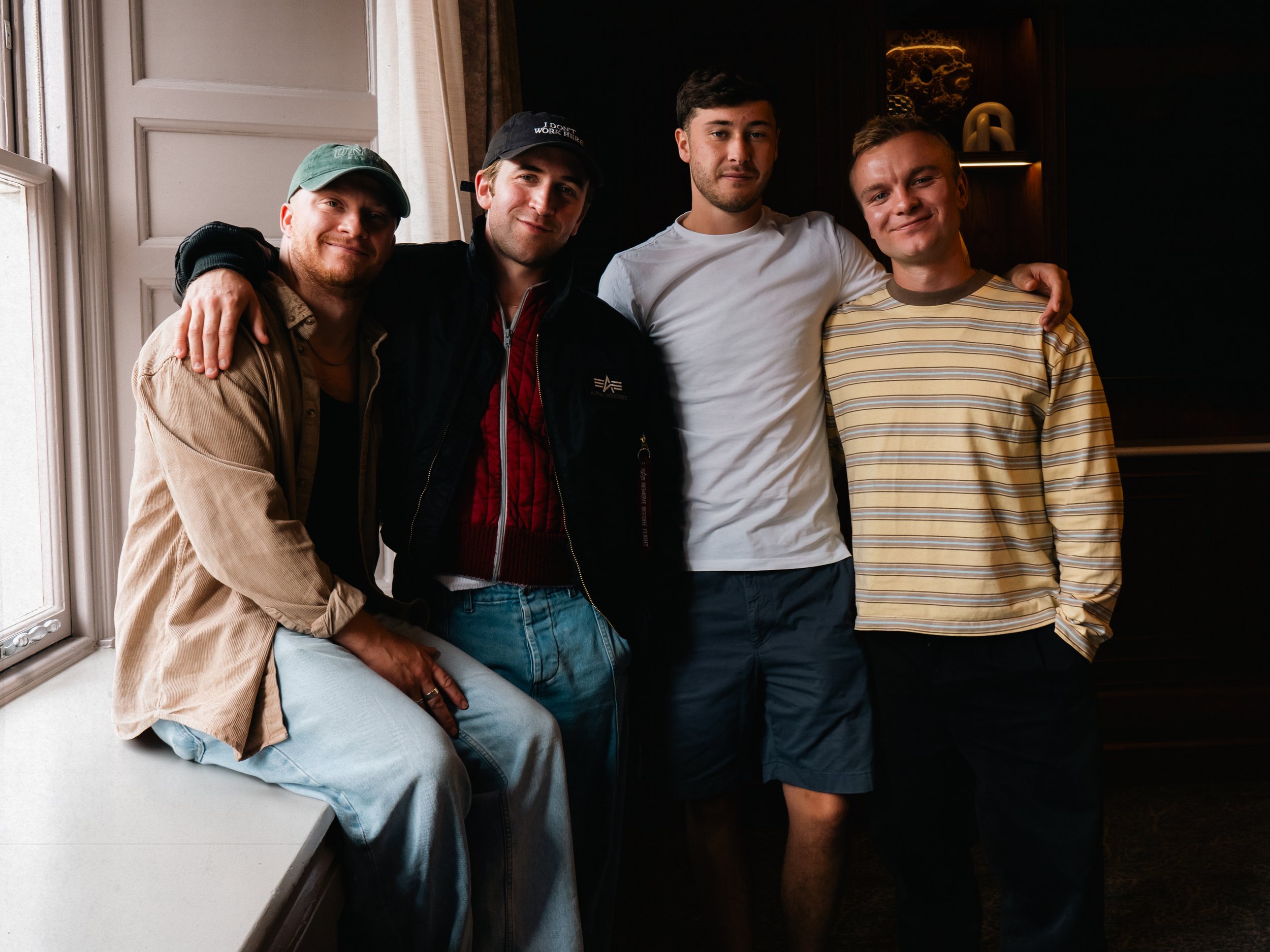
Ollie Gardner, Callum Scott Howells, Samuel Bottomley and Jake Harvey. Photographed by: Joseph Clarke
The debut feature from best friends turned directing duo Ollie Gardner and Jake Harvey, The State of Us follows mischievous outsider Frankie (Samuel Bottomley), who, struggling to come to terms with the possibility of losing his best friend Taylor (Callum Scott Howells) to cancer, breaks him out of hospice care for one final night of chaos. But what begins as night of fun and partying quickly turns more serious, as the two friends are forced to confront some hard home truths in the wake of impending tragedy.
Whilst the coming-of-age ‘night out’ is not a new premise, The State of Us feels quietly groundbreaking in its depiction of masculinity and male friendship, embracing both the intimacy and power of these relationships in a way that is still rare to see on screen.
Helmed by two of the UK’s most exciting young actors with a screenplay from Harvey that perfectly balances the tonal tightrope of the film’s subject matter, it’s no surprise that The State of Us delighted the sold out crowd at its world premiere at Edinburgh Film Festival last month. A few days after it debuted, MASSIVE caught up with Ollie Gardner, Jake Harvey, Callum Scott Howells and Samuel Bottomley to talk about the film’s personal resonance, its nuanced depiction of masculinity, and its various homages to coming-of-age classics.
Hannah Stokes: Jake, I know The State of Us is a very personal story to you. How did the film initially take shape, and how did you go about casting your two leads?
Jake Harvey: It’s based around friends of mine that I grew up with, and Taylor is sort of inspired by the outlook of our friend who passed away when he was 18. We wanted to do something that was a rough and ready, fun look at how lads navigate impending grief when they're at an age where they're not totally equipped as to know how to talk about it. I wrote the film in lockdown, and I've been working on it for the past 5 years. The idea was basically to look at what a conversation and a relationship looks like on this night out between a character who is physically dying, but mentally sees the beauty in the remaining days that he has left, versus a character who is physically very able, but can see nothing useful in the world, other than his best friend. So that's the sort of central paradox of the film, that clash between them and the film is about where that conversation goes, and is their friendship ultimately the most beautiful thing about their own lives in, in the course of this night out?
Ollie Gardner: The film lives or dies off the chemistry between the two lads, like we knew that going into it. And so it was all about finding not only just two brilliant actors, but two actors who had that chemistry with each other - that was by far the most important thing for us. When we were doing some chemistry reads, we saw some amazing people, but as soon it was these two lads, we knew they'd be perfect. We've always said that this is a film made by two best mates, about two best mates. So we knew that not only did they need to have chemistry with each other, but that there needed to be that chemistry between all four of us. So then it became like four best mates making a film, which I think is ultimately, hopefully, what comes through. We just had so much fun doing it, really.
HS: For you guys, Sam and Callum, what first drew you to the project?
Samuel Bottomley: My agent was talking about the script. She'd read the script before me and she was talking about it for a while, and I was filming up here in Edinburgh actually. And she said “When you’re done with this, you need to go have a meeting with these people who really want you to read for this role”. I’d actually met Ollie and Jake a year are so before, on Zoom, so once I finished filming California Schemin’ and I came back down, we had a chemistry test with a load of different lads. Ironically, Callum wasn't in there, so I didn't actually meet him until we started filming. But as soon as I read the script, I knew it was a special story and that I definitely wanted to tell it. After the chemistry test, I didn’t really know the vibe because they were like really, really positive towards me, but I'd not been offered the job yet. So I was like, sort of like, “I think I've got it. I don't really know, though." [laughs]
Callum Scott Howells: I met these boys in the National Theatre. Where else? [laughs] They had this idea for me to play Taylor and we were talking about how far I would be up for going in portraying him authentically. It involved changing my body because I guess at the time I sort of had, like, a certain amount of muscle mass probably wasn't right for Taylor. We just needed to trim him down because obviously with cancer, your muscles do start to disappear, especially at the stage Taylor's at. They gave me a nutrionist and stuff, and it was the first time I'd sort of physically challenged myself - to this extent - for a role. So I was like, "You know what? It's gonna be so exciting".
But then also, first and foremost, the script I just thought was probably one of the most remarkable things I've ever read. I think it really captures these two boys who are at a stage in their life where they’ve got all this history behind them, and they’ve reached this incredibly pivotal moment in their lives that will effectively change them forever, you know? And I just thought, what an amazing thing to try and capture in one night, in a film. I don't know, I feel like in this country, we haven't really seen that before. I certainly haven't read scripts that have had this sort of urgency to them. So I was very excited by that, and when they told me that they were talking to Sam about playing Frankie, I was like, "Oh my gosh." [laughing] Because I've been a fan of his for ages, so I was like, "Oh, this is gonna be awesome."
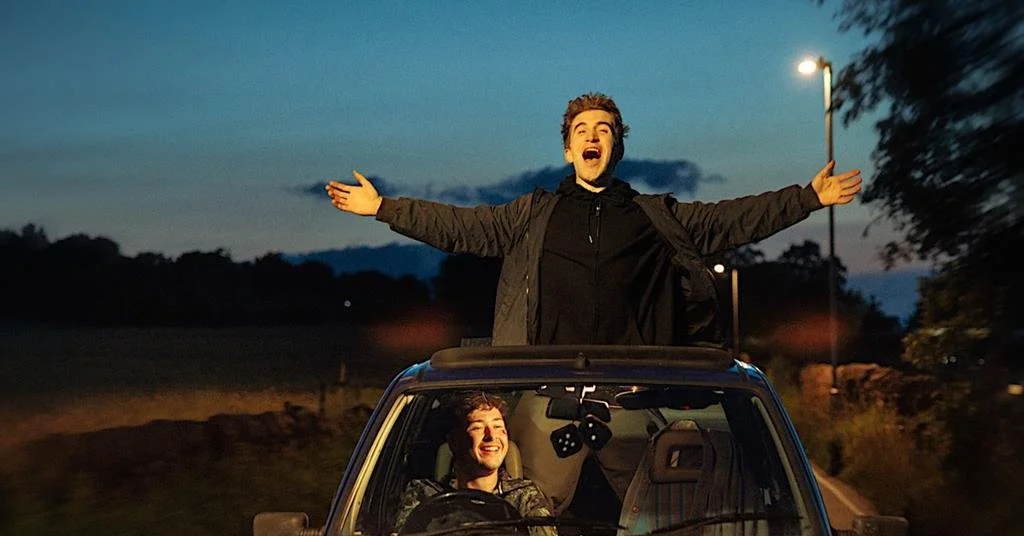
Callum Scott Howells and Samuel Bottomley in The State of Us, courtesy of Edinburgh Film Festival.
SB: I remember reading the original script and it was more set in the pub wasn’t it? It was different.
JH: Yeah. Once we sort of had Sam in mind for the role, his voice kind of started to inform the character quite a lot. Throughout this process, there's never really a point where the script locks. It was always evolving, even on set. Like we're all sort of navigating it, and these two lads, why they were so special is because they're also pouring in their own experience with their own friendship groups. And I think that lent the script a sort of authenticity that meant it could be shared by not just one story, and it was something that other people could relate to.
But the core conversation of the script was pretty much the same, and we were grounding it by always asking ourselves the question, if this was you breaking in to steal out your mate for your final night out possibly ever, how are you doing it? And what drives Frankie to do what he does during the film?
OG: It’s also really easy to fall into the trap of having to feel like you need to be ‘big’ in a film, and have big set pieces and big narrative arcs. And actually for this film, the whole thing is a conversation between these two young men. And so it wasn't about how big can we go, it was more about how much can we pull it back, how much can we ground the story? The house party scene for example, it’s this really visceral, real house party. This isn't like a fraternity house party that we see in American movies.
SB: It's rough and ready.
OG: This is a rough and ready house party, which is what we all know growing up. And it was like, okay, what are those moments we can find to pull it back into this, like, grounded reality? And I think it gave it this rough and readiness that feels really British, looking at it, we feel really proud of that. But also for the story, it means that the focus is on their relationship with each other, not these crazy set pieces that they're going on. So yeah, it lives in the conversation rather than the, the plot, I'd say.
HS: I was interested when Callum mentioned the sense of urgency that the script has, because I know that you only had 12 days to shoot the film. I know that wasn’t necessarily your choice with your shoot time being cut, but with this film literally being about running out of time, do you feel that that aspect added to these sense of urgency we see on screen?
OG: Yeah. I've never thought about it that way, but it is totally true. I think we said the other day in a Q&A after the screening, had we had five million pounds given to us and six months to go shoot this movie, it would not be the same movie. And actually, I think it would be at the detriment to the movie. I think the twelve days gave us that sense of urgency. It forced us to do things in a certain way, and also pull back and rethink how we were going to do things. We did do really long takes and also fewer takes, which turned out to be beautiful because these boys have an incredible skill to be able to give you a first take and also run these really long takes, so that was amazing. You know, whenever you have these logistical problems in independent film, there's always creative solutions. I think that added a lot with our conversation. We had an amazing DP, Yunus Roy Imer, who could basically work with any scenario. He was like, "Give me the camera, put it on my shoulder," and he can run a scene. And when you have people like that on set who are bringing their best possible work, then you realise how quick we can do it. I mean, we shot in twelve days, but we didn't go over on any day, which is unheard of.
CSH: It puts some TV sets to shame. [laughs]
SB: I think it's a domino effect when you see someone working so hard and you know you're against the clock. Like, everyone sort of falls into place, everyone's firing on all cylinders at like 4:00 in the morning because we've only got half an hour left of sunlight. Do you know what I mean?
OG: It's a good pressure, isn't it?
SB: Yeah, definitely.
CSH: And I think you feel it. I definitely think in that hilltop scene, part of the urgency is there, that we had to get it done. It almost then reflects in the playing of it with me and Sam - there's a sort of literal clock on us as actors, but also this clock in the film. Like it's all there and it's all sort of metaphorical and figurative, but also sort of beautifully tragic. And I just love that idea. When I watch it back, I can see, like, me and Sam there and hopefully the mainstream audience will know that, but, they'll feel it too, you know? They'll feel that sort of visceral energy to it.
HS: I think they definitely will. With the shoot being so short but the success of the film being contingent on the friendship between Taylor and Frankie being believable, how did you guys work to build chemistry in such a short period of time?
JH: We did a week of rehearsal, and for us it was actually about just sitting in a pub and chatting, and the license to do that creates the space where we can all trust in each other. These boys have to go to some quite dark places to play the characters they play - they have to trust in us and we have to trust in them. So we needed to create an inherently safe space in which they can do that. So actually, the work was done in kind of getting to know each other.
CSH: We were messaging a lot before as well. Sam sent me lots of voice notes, because I had to do the Bradford accent [laughs]. And I just said, "I don't care what you say, just chat absolute shit to me over voice note." I love it. I just want to play them back actually. [laughs] It was great. But I suppose with our chemistry as well, really we were just talking about nonsense, weren't we? Like I remember we just had our football conversations and music conversations. Sam would be like, "what music do you like?" and then we'd just start talking about any old rubbish [laughs]. I'd like to sit here and be like, you know, "We had these really intense chats about this or that." But actually, I think how you create trust is just by getting to know each other on a certain level, and then everything else comes naturally. And I suppose that's what was so beautiful is that I think we'd all just clicked, didn't we? Of course, me and Sam trust each other, but I feel like we’re smart enough actors to also know we have to do it anyway. But then also it came with these boys, Ollie and Jake. It was the four of us actually, there was this sort of synergy and allowance to express ourselves in this safe space. And that's what I was super grateful for.
SB: Yeah I realised I was surrounded by three very strong men, who had a massive vulnerability and a massive emotional depth to them all. So you feel like you're in really safe hands whatever you do and wherever you go.
HS: I think the film is a very refreshing depiction of masculinity. There’s definitely still a level of male bravado within Frankie’s character, but there’s also such a softness to Frankie and Taylor's friendship, which I don’t think we see portrayed on screen very often. As both directors and actors, how important was it for you to depict a more nuanced and more intimate portrayal of masculinity and male friendship?
JH: I think if you're going to try and tackle this relationship, it would be so untrue to have them be immediately vulnerable. Like, lads just don't say what they're feeling at the very first instance, especially at such a young age, you're never equipped with the know how to navigate these things. I think it gives the film a space to show what the toxicities of masculinity are in a very honest and natural way. And then everything past there is something that has to feel natural and has to come from a place of - underneath all these jokes, there's actually a kid in there who's crying out just to say what he really feels. So I think from a masculinity point of view, we really wanted to just add to that conversation and show what young men actually deal with and how they'd go about it when they're going through this.
OG: I mean the topic of masculinity is obviously incredibly complex, and as Jake said, we really just wanted to add to it. You know, I'm not sure at the moment that masculinity and toxic masculinity are any different. I think they're synonymous with each other probably. And I don't know what this depiction of positive masculinity is, but we want to try and move the conversation on from the amazing work of things like Adolescence and Inter Alia, which are like shocking audiences into like - this is real, this is happening. And we're kind of going, "Okay, well, what's next?" Like, can we have a character like Frankie who has these incredibly toxic traits to him, but his one redeeming factor is his relationship with his best friend? And the vulnerability that comes with that, and that being a platonic relationship with another man and being able to tell each other they love each other and being vulnerable, is a really beautiful thing. It’s something actually that - you know, there is a lot of toxic, awful things that are being spouted to people, especially on social media. But growing up, I'm very lucky with my male friendships, not only in this room with all these boys here, but actually my boys growing up, my boys I met at university, that I feel really, really privileged that I've also had a really positive experience with all my male friendships. I know that's not true for everyone, but I think for this film, it's about going, you can have a joke and you can take the piss out of each other, that’s just part of being a friend. But you just need to be able to also know that you can be vulnerable and can tell your best mates you love them, and that needs to be there, and I hope this film sort of furthers that conversation on. We just want to contribute to what comes next, and show young men that, yes, this is really awful, but also show them maybe something to aspire to or aspects that they can aspire to in their other male relationships.
JH: The other thing that came up when devising the idea of the film is that cancer for one character is, it's not really about that element - like that isn't really a theme in the film, it’s more of a lens. And it's the way of, as much as Taylor didn't choose to have cancer, fate kind of decided that for him, a lot of what makes Frankie who he is and these toxic traits were never his fault in the first place, or not inherently his fault. Like, his backstory as a character informs the place that he gets to and the person that he is quickly becoming. And that toxic male never actually... he didn't start in the world trying to be a dickhead, it's just what's around him informs that and creates that person.
CSH: I don't think… Taylor and Frankie, they probably had very little conversation about toxic masculinity, these two [laughs]. But I think then sort of subconsciously, obviously in the film there's a lot of conflict between them, with Taylor calling him out on his actions and stuff. And it's really sad because obviously a lot of it is down to what his situation has done to him mentally, and how that's affected his outlook. But it's kind of a calling card for Frankie. It becomes this thing where he's like, "Fucking hell, mate, you wanna actually carry on doing this shit, like, treating people this way, you know?" And making him think "You can be better. You can have a good life. Take what I can't have and run with it.".
SB: I don't think I've got much more to add, but yeah like you’re right, most men aren't gonna sit down and have a conversation in the pub about toxic masculinity. But maybe people are going to watch this film and have a quiet moment for the next five minutes afterwards, and then they're gonna crack on, and that’s the beauty of it.
CSH: It's those moments in the film, like where Frankie is in the bathroom with Esme and he whacks the door, and I think when we see those moments, it really hits you hard, as a man. When you've seen these moments and you've witnessed them in real life and then you see it on a screen, it just really does something. There's something really uncomfortable about it. I think the situation between Taylor and Frankie is a great framework for actually being uncomfortable with what the reality of what the story is, and when we see these actions played out within this framework, there's something that makes it quite uncomfortable in places.
OG: Yeah, I totally agree. I mean, you never go into a film being like, "We want to make a film about toxic masculinity", do you know what I mean? Like, this was a film about two best mates, going through a really hard time in their lives. Throughout that, all these things are going to arise and come up. We kind of came out of it with all these questions, but we never went into it knowing them.
JH: No, you can't chase it, otherwise you're looking for something that isn't about an audience-facing idea.
OG: You're right. Lads aren't gonna go sit in a pub and interrogate it to that degree of saying ‘toxic masculinity’, but they'll go in and interrogate each other's actions, in context, and that's important. That's really important.
HS: I was also interested in the choice to set the film in Bradford, which I know is where you’re from Sam. Apart from classics like Kes and The Full Monty, and a few recent films like God’s Own Country and Ali & Ava, there’s not a lot of films set in Yorkshire, let alone Bradford, and I haven’t really seen a coming of age story like this set up north before. For you Ollie and Jake, was it always written into the script that the story would take place there?
OG: No. You know, fundamentally, this is a film about two lads which could be placed anywhere, it is a universal story in that sense. I really fundamentally believe that these two lads could be placed anywhere and people would see themselves in it.
JH: It very intentionally had no sense of space.
OG: And then it became quite important for us to take it out of London. I think there's a lot of work being made in London, and we wanted to take it out of that voice. We never landed on Bradford really until Sam, and it felt so authentic. I think what we were looking for is a space that could give everything to the film. When we were talking to Sam, the authenticity and the love and passion that he has for his hometown is amazing, and I think that's quite infectious. We were suddenly going, like, "Why are we trying to manufacture something to a place we don't know? And why don't we lean into that instead?" Like we can go to all the places that Sam's showing us, and it feels real. There’s also this nostalgic element to the film, we feel. It's part of the reason we put it into 1.6.6:1 aspect ratio, because it has this nostalgic element to it, which is throwing it to sort of like 90s filmmaking, things like The Full Monty or Billy Elliot. These are films that inspired us, and we feel like that voice is sort of lacking at the moment. We kind of just wanted to take it out of London and I think it grounds the story with these two lads, which doesn't feel lofty in any way. I think that was quite important to us.
JG: Thematically, it was really important to have one space that both these boys were born into, and grew up together in. And yet at this point, at this junction in their lives, they both see it through two very different lenses. So for Taylor, like what's amazing in Bradford is you turn left and there's some of the most incredible landscape in the country, and you turn right and there's this kind of really interesting, gritty industrialism to it. So it was really important that when Taylor breaks out of the hospice, he sees the natural beauty of the world. And when Frankie's sort of leading the charge on this night and dictating what they do, that he drives them into the sort of grittier underbelly of the city. And I think that was really important that that sense of space captured their two outlooks.
SB: Callum, you was quite pleasantly surprised, weren't you? [Laughs]
CSH: Bradford? Oh my God, absolutely. I thought it was so rich with history and like really kind of harsh, you know? It's similar to where I grew up, but obviously it has its own identity. I think we were all sort of victims of what went on, obviously post the mines shutting down and everything post-industrial, you can just see it, all that stuff there. And I think it's really interesting, that nostalgia aspect, because there's also something about this generational trauma just seeping in, right? Those sort of things that just really bleed in. Another aspect I'm really proud of in the film is that you've got this lovely device where you see the young Taylor and Frankie and then the older Taylor and Frankie, and what happened in between is what you see in Bradford. It's there throughout those shots.
SB: Can I just add something? It's going to be very cringey. What’s that song? There's a song and it says, "We live in cities you'll never see on screen."
HS: Yeah Team by Lorde! I love that song.
SB: Yeah I remember listening to that on my way back home from school in my nan's car, and looking out the window, and I could see where she was talking about, like some random place in America that you don't see very often, and I found that way more interesting than anywhere else you could see on screen. Do you know what I mean? I'd love to do it more. I'd love to work with Screen Yorkshire more, I'd love to just do these rural stories because they haven't been seen. I think that it's important that people in these places see themselves and the people around them or their surroundings on screen. You mentioned Ali & Ava, and I saw The Selfish Giant when I was a kid, and that was the first time I'd ever seen my Bradford on screen. And it was so, so inspiring. So yeah, very proud to do it and to take it on.
HS: I know Ollie you mentioned the The Full Monty and Billy Elliot - were there any other films that you guys watched to try and inform how ou wanted this film to feel?
JH: When we were writing the film, what's really interesting about the one-night structure is you've got to tell so much history, and so much history about a certain relationship, in a very short space of time. And you never want to be building dialogue which is trying to tell the audience what's happened to them all before. So one of the devices we actually leaned into is to pay homage to some films that we really love and capture that, those types of relationships, so that when someone's watching it, they see something in it that they've seen before, and that actually lends itself to building the depth of the two characters. So the opening of the film is very much inspired by Good Time, which was actually the last film I watched before writing the script. And that obviously informs the kind of break-in into the hospice. And then, one of the really most beautiful films I think I've ever seen is the Belgian film Close. It was one of the first times I've seen young kids having dialogue between each other without saying anything, in a really interesting and nuanced way.
I also think it's kind of interesting jamming together references. There's The Perks of Being a Wallflower reference, which, you know, it's unapologetic, but it's very much like that, that's the same sort of relationships that are in that film. A bit of The Inbetweeners as well, there's a visual nod to it. But it's all very intentional because even The Inbetweeners elements are, hopefully for the young people that watch this, to actually be pulled into something they'll have a good time watching and then maybe feel something. So I think all the elements that were blended into it are very different in their own right, but are equally kind of important in showing these different layers of friendship and masculinity.
OG: Yeah. I think they're good references. It’s almost so surprising how many references this film is able to pull in. It’s not a long film, and I think it's kind of bizarre that this story can reference Good Time at the same time as The Perks of Being a Wallflower, at the same time as referencing Close, at the same time as referencing The Inbetweeners. Like if you saw that on paper, you'd be like, "Oh my God, this is so confused." But it doesn’t feel mismatched because they're all stories about different relationships and friendships and different versions of masculinity. Like, there's no right or wrong, all of these different things can co-exist with each other. So in a way, it feels quite a necessity to point to these other things to go like they can have a Perks of Being a Wallflower moment, and the banter could be Inbetweeners, that there’s no one way of doing things. They are quite pointed, but in a very intentional way, to make people go, "Oh, right. I see that reference, and isn't that bizarre that they could pull all these different things into it?" So yeah, they're more like our homage to those beautiful films, really.
JH:The Inbetweeners reference visually is the most sensitive, un-Inbetweeners moment in the whole film. So it really captures the intention of blending those two, that feeling and the nostalgia of it with the actual sort of hopeful new sense of that.
CSH: I love that stuff. [laughs] Like genuinely, when I read the script I loved that it made me cry, and then I also thought of The Inbetweeners. It was one of my favourite shows growing up. I'd re-watch it all the time. And when I saw the car, I was like, "This is all fun", and the fact that we can then put this beautiful story with all these lovely things that me and Sam were able to bring to the table, but frame it in these kind of cool little references and these cool nods to things. I love that. I really enjoy that stuff. And I actually really love when I see little sort of cheeky wink, wink, nudge, nudge moments in film. It's what keeps the community flowing. Do you know what I mean? Because then there are really lovely original parts to it as well, like the scene at the house-party when the lights go red and its just Taylor and Frankie on the dance floor. I'm so moved every time I watch that back because the boldness of these boys' debut feature is so brilliant. I loved also how it takes big swings as well when it wants to. And I think that's credit to these guys and how brilliant they are.
HS: What do you hope audiences take away from this film?
OG: I think that there's the obvious that we've been speaking about, about the topic of masculinity. And we really would love young men to see this film and see themselves in it and continue that conversation. And for the older generations to have that conversation, whether they have kids or grandkids, that's really important. But also, as we've often said you kind of want to go out there and call your best mate and tell them you love them, and fundamentally, that is the most important thing. If it can remind you of those friendships you have, whether they're with another man or whoever, like, that doesn't make a difference. Just make sure you hold the people close to you, I think.
JH: Yeah. And I think that feeling should come with a smile rather than any other feeling. Like it should kind of give you butterflies thinking about your best mate, hopefully. I think the choices we made visually for the film are so when you look back at it, it does have that nostalgic quality, and it almost feels like you're looking back on a night out with your own best mate, and it kind of lends itself to the one-night structure, so you almost remember it as a night out. You go on this night out with these boys, and you get stuck into it. That's the hope, is that you feel really on the journey with them.
SB: There was a lady that came out the film yesterday and she was crying, or she was like nearly crying when she was speaking to Jake and then looked at me and I just gave her a hug and, like, cried with her. [laughs] So yeah, just to sort of look at the friendships and the relationships that they have and be grateful for them and be grateful for the time that we get with the people that we love.
HS: How do those kinds of moments feel for you, when you have made something that is so emotional and you see audiences visibly react to it?
CSH: It’s so lovely to be part of something that means something to people, and resonates with people. Like, that is rare. For me, the last thing was It's a Sin, and since then, nothing I’ve done has had that sort of impact on people. But I feel like this, I feel so proud of. I really feel like this properly represents a generation of people. I feel so proud because I see all my mates in this film, all of them, including the women, actually. In terms of what I want people to take from the film, it would be to just be kind to each other. Like, we’ve got such little time on this earth - be there for each other and love each other. Don’t hold grudges and don't be so harsh on people. Because it’s a short life, make it a good life.
OG: The only thing to add to that, really, is that it's a privilege to be able to make something and have people respond to it, and I think you can sometimes lose sight of that when you're making a film. You know, sometimes with film and with art in general, not just the art that we're making, it's quite easy to just see it as this critical thing that you have to pick apart and take everything out of it, and put a magnifying glass to every single decision you make. And it's quite hard to detach yourself from that sometimes. But when you're sat in an audience and you're seeing lads that we know, lads who would never normally connect with this sort of story come out crying, saying how proud they were, saying how much they loved it, that's who the film's for. And if it can touch an audience like that, I think that's all we were ever trying to do. You know, whatever this film does or becomes, whatever that is, is out of our hands. But when you're sat in that audience and you're experiencing it together and it's affecting people, it feels like we've done our job.
JH: Selfishly, there is no better feeling than coming out the cinema and someone coming straight up to you and telling you about their best friend. Like that has been the best thing about this whole experience at this festival is, you go outside and you chat with a friend and someone comes up and all they can do is just tell you about their mate. If they can see their mate in the film, then that is like- we've won. [laughs]